

A Nigerian medical professional, Ugo Bright Malek, has found himself at the center of online outrage after a Facebook post many have described as openly misogynistic.
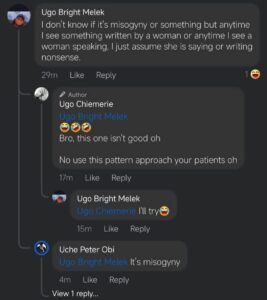
It began with a statement he shared publicly:
“I don’t know if it’s misogyny or something but anytime I see something written by a woman or anytime I see a woman speaking, I just assume she is saying or writing nonsense.”
The comment might have been dismissed as a poorly thought-out joke, but the tone shifted when another Facebook user warned him not to apply such thinking when treating patients. His response, “I’ll try,” followed by a laughing emoji, only deepened concerns.
Within hours, screenshots of the post circulated widely, drawing criticism from Nigerians who questioned how someone in the medical profession could casually admit to holding such a bias.
At the heart of the backlash is a larger issue that extends far beyond one Facebook status: misogyny.
Misogyny is not always loud. Sometimes it hides behind humor, sarcasm, or cultural norms. But in this case, it was plainly stated the assumption that a woman’s voice, by default, lacks value.
For many women, this assumption is not new. It plays out in meetings where their ideas are ignored until repeated by a male colleague. It appears in classrooms where girls are subtly steered away from certain ambitions. It surfaces online, where educated and accomplished women are dismissed as “too loud,” “too opinionated,” or “too much.”
The roots of such attitudes are often tied to insecurity. As more women pursue advanced education, build successful careers, and claim leadership spaces, some men struggle with the shift in traditional power dynamics. Instead of embracing equality, insecurity can morph into resentment. Instead of collaboration, it becomes competition.
Dismissing a woman’s words before she even finishes speaking is not a reflection of her intelligence. It is often a reflection of someone else’s fear.
The fact that the man in question is said to be a medical professional raised even more alarm. Healthcare demands empathy and objectivity. Women already face documented challenges in medical spaces, where symptoms are sometimes minimized or overlooked. A publicly declared bias only amplifies concerns about how deeply such attitudes may run.
The controversy arrives at a symbolic time. In a few days, the world will mark International Women’s Day on March 8, with its theme: Give To Gain; a global celebration of women’s achievements and a call to action for gender equality.
International Women’s Day is not merely a date on the calendar. It is a reminder that progress is ongoing and that mindsets must evolve alongside it. It challenges societies to confront the everyday prejudices that continue to limit women’s full participation.
For many women watching this story unfold, it may feel familiar. Another example of voices dismissed, competence questioned, intelligence doubted. But it also serves as a reminder of why these conversations remain necessary.
To every woman who has ever been underestimated, your voice is valid. Your education is earned. Your success is deserved.
The presence of misogyny does not diminish your brilliance. If anything, it underscores how powerful your voice truly is.
As International Women’s Day approaches, the message is clear. Women are not background noise. They are leaders, thinkers, innovators and change-makers. And no assumption, however casually spoken, can silence that reality.
