

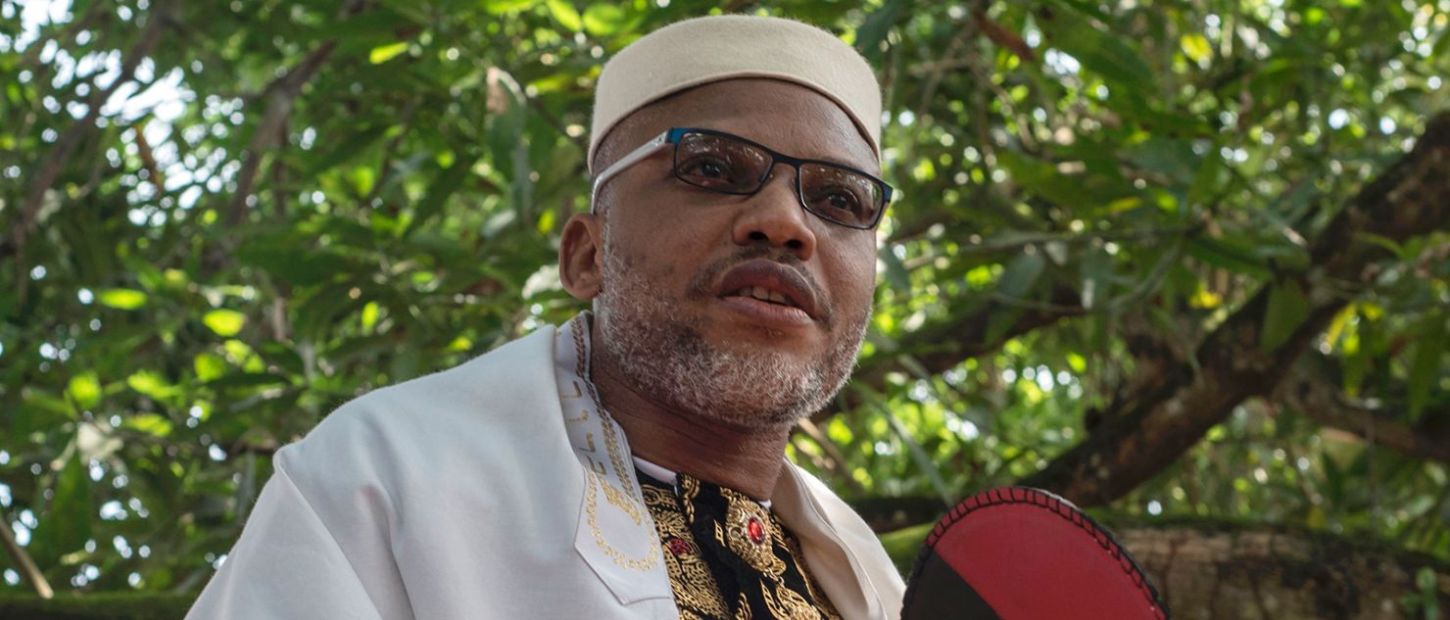
So, let’s unpack what’s happening with Nnamdi Kanu’s latest court ruling, because the reaction from his family is not small at all. They’re not just saying the judgment is wrong, they’re calling it a legal disaster, a violation of due process, and something that should concern anybody who cares about how the justice system works.
This isn’t about politics alone, it’s about whether a person can be tried and sentenced under a law that technically shouldn’t even exist anymore.
Let’s break it down.
1. The Core of Their Anger: “You Can’t Use a Dead Law to Judge a Living Man.”
Kanu’s family basically says: The law used to convict him was already repealed.
Meaning, it had been removed, scrapped, no longer active.
In normal legal sense, a repealed law is like a deleted file. You can’t use it. It’s gone.
But the judge leaned on a “transition clause,” something that wasn’t even part of the arguments raised in court. And that’s where the family says the problem began, because judges are supposed to decide based on what’s argued before them, not bring in new angles on judgment day.
The family calls this move a legal ambush. And honestly, if a judge uses a provision that neither side expected or discussed, that’s a valid complaint.
2. Section 36(12): The Big Constitutional Issue
They also point to Section 36(12) of the Nigerian Constitution, which says:
No one can be convicted for an offence that is not defined by a written law.
In other words, if the “written law” (the law governing the offence) has been repealed or removed, then there’s nothing to convict anybody with.
Kanu’s family insists:
If the law is gone, the charge is gone. Full stop.
This is a foundational legal principle, and it’s not unique to Nigeria. Almost every civilized justice system follows it.
3. The Supreme Court Already Ruled on This… and Was Ignored?
According to the family, there are existing Supreme Court decisions that back their argument. So they feel the judge not only deviated from the arguments made in court but also ignored binding legal precedents.
In law, when the Supreme Court has spoken, lower courts are expected to follow, whether they like the ruling or not. That’s how judicial hierarchy works.
So the family sees this judgment as stepping outside the rules entirely.
4. Why They Call It “Dangerous”
Their biggest worry isn’t even about Nnamdi Kanu alone.
It’s about what this kind of judgment means for future cases.
Because if a court can:
- use a repealed law,
- ignore higher court rulings,
- introduce a new legal angle nobody discussed,
…then anybody, at any level, could be exposed to unfair judgment.
Think of it this way:
If referees can change the rules of a football match during the game, nobody is safe, not even the team winning at halftime.
That’s their point.
5. So What Do They Want?
The family calls the judgment:
- Illegal
- Unconstitutional
- Null and void
- A denial of fair hearing
And they want it thrown out completely.
They’re essentially asking the judiciary to redo the process, but this time, within the boundaries of the law as it exists.
6. The Bigger Picture
Beyond the legal talk, this situation raises a bigger question:
Can Nigeria’s justice system be trusted to follow its own rules when high-profile cases come up?
Whether one supports Kanu or not, his family’s argument touches on everyone’s rights. If the law is applied inconsistently, or creatively, then anybody could be vulnerable to legal overreach.
This is why their rejection of the judgment is loud, firm, and backed by some serious constitutional claims.
