


Earlier in March 2026, Nigerian Afrobeats singer Crayon sparked a major social media storm by posting a series of emotionally charged messages accusing his former label Mavin Records, its founder Don Jazzy, and other associates of wrongdoing following what appears to be his exit from the imprint. The dramatic outburst, which included comments that “Mavin is going down” and accusations against label executives, was widely shared and quickly trended before many of the posts were deleted, leaving fans and industry observers to question what was really going on behind the scenes.
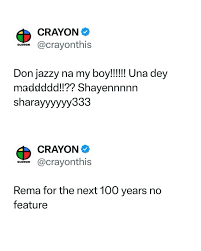
The controversy is unusual not just for its tone but for the way it exposes the emotional pressure that can weigh on artists in the Nigerian music industry. Crayon, who signed with Mavin in 2019 under Blowtime Entertainment, the label’s imprint, has been one of the label’s rising talents, known for hit songs like Ijo Labalaba and collaborations on projects that have made significant cultural impact. But rather than seeing his career growth as the outcome of a smooth partnership, his recent posts suggested frustration and unresolved tension.
Part of the discussion online leapt immediately to the personal: there were serious allegations, including a claim from Crayon that Don Jazzy was connected to circumstances around his mother’s death, though no details were elaborated and the tweets were removed shortly after posting. The emotional context here cannot be ignored, Crayon lost his mother in 2025 and has publicly spoken about how deeply painful that experience was for him. He described her death in deeply personal terms, noting how important she was in his life and how profoundly her loss affected him. Whether this tragedy directly influenced his online reactions or not, it added a layer of vulnerability to a story that has otherwise played out on the very public stage of social media.
Industry voices have also weighed in. Nigerian producer Samklef publicly reacted to Crayon’s statements, pointing to the complex dynamics within the industry and even suggesting broader frustrations with how Mavin’s artists have been perceived to “blow” or not in recent years, though he himself conflated personal grievances with social media speculation.
From a broader music business perspective, Crayon’s outburst highlights long‑standing tension points that exist not just in Nigeria but globally: artist–label relationships, royalty transparency, creative control, and mental health struggles. Record labels like Mavin have played an undeniably central role in developing Nigerian talent, nurturing artists such as Rema, Ayra Starr, Korede Bello, and others to international prominence, and even attracting major investment from global players like Universal Music Group in recent years. Yet that very structure, with its contractual expectations and financial arrangements, can create friction when an artist feels unheard, under‑compensated, or emotionally unsupported.
The silence from Mavin Records and Don Jazzy has been notable, with no official response as of this writing. That may be strategic, as labels typically avoid amplifying controversies by engaging publicly. But it also leaves room for speculation, which social media is always eager to fill.
Ultimately, this episode is a reminder that the Nigerian music industry, while rapidly maturing and breaking global barriers, still has growing pains. The structures that help artists cross continents must also reckon with the very real human experiences behind the music, grief, frustration, unmet expectations, and the search for agency. Whether Crayon’s social media outburst marks a genuine parting of ways or a moment of emotional expression under strain, it invites an important industry conversation about how talent and labels relate to each other in an era of global Afrobeats prominence.
