

A Twitter user shared a story that has not left my mind.
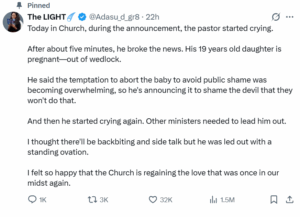

According to her post, her pastor broke down in tears after delivering his sermon. Not because the offering was low. Not because attendance dropped. But because he stood before his congregation and told them that his 19 year old daughter was pregnant out of wedlock.
In an age where image is everything, especially in church leadership, that kind of public vulnerability feels almost shocking. And it immediately raises a bigger question. What does “family” truly mean in today’s church?
I’d say, growing up in church for me gave me a fair share of the good and bad sides. You’d have your life monitored especially as a pastors kid, so, I can really imagine what the Pastor in this context was going through, or what he had to chest to make this big reveal.
Because let’s be honest. Modern church culture can sometimes feel like a carefully curated brand. Perfect couples. Perfect children. Perfect testimonies. Perfect Instagram captions. The pastor’s home is often presented as the gold standard. A spiritual showroom where everything looks polished.
So when a pastor publicly admits that something “imperfect” has happened in his own home, is it embarrassing or is it honest?
The tweet described the moment as emotional. The pastor did not defend himself. He did not shift blame. He did not pretend everything was fine. He wept. And in that moment, the church was not just a stage. It became a family room.
But here is where it gets deeper.
For years, many churches have described themselves as “one big family.” Yet how many truly function like one? In some congregations, members only know each other on Sundays. In others, struggles are whispered about, judged, or quietly punished. There is prayer, yes. But is there safety?
Family, in its healthiest form, is not about perfection. It is about accountability, support, correction, and love coexisting in the same space. It is about being able to say, “This happened in my house,” without fearing exile.
So when that pastor cried before his church, was he disgracing his office? Or was he redefining leadership?
There is something powerful about a spiritual leader who does not hide behind the pulpit. By sharing his daughter’s situation, he unintentionally challenged a culture that often pressures pastors’ children to be flawless. He reminded everyone that being called does not make you immune to life’s realities.
And let us talk about the daughter for a moment. In older church cultures, situations like this could lead to public shaming or silent suspension from activities. But if the church truly believes it is a family, then the response should mirror what many families strive for in hard times. Support first. Correction with compassion. Restoration over rejection.
The good part of this was that the church embraced him, they accepted them with warmth unlike some churches that will castigate and push you behind. Some can even go as far as ostracize the family.
The modern church stands at a crossroads. On one hand, it has embraced media, branding, and global visibility. On the other hand, it risks losing the raw, communal essence that once defined it. The early church model was deeply relational. People knew each other’s struggles. They carried each other’s burdens.
Have we replaced that with optics?
This pastor’s tears, as uncomfortable as they may have seemed, brought the conversation back to something foundational. Church is not a museum for perfect people. It is a gathering of flawed humans trying to grow.
Maybe the real question is not whether his daughter’s pregnancy was embarrassing. Maybe the real question is this. If something similar happened in your church, would it be handled with grace or gossip?
Because until the church can respond to real life with real love, calling itself “family” will only be a slogan.
And perhaps, in that moment of public vulnerability, that pastor reminded everyone what family is supposed to look like. Not spotless. Not staged. But honest.