For generations of Nigerian graduates, the National Youth Service Corps (NYSC) has been a rite of passage. It has produced countless stories: friendships that became lifelong bonds, marriages that started in camp, unforgettable camp experiences, and of course, the famous “one year in khaki” memories.
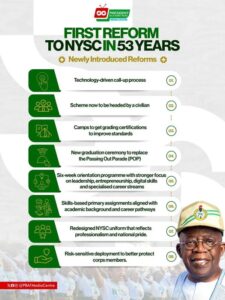

But beyond the nostalgia, there has always been a bigger question: what exactly is NYSC preparing young Nigerians for?


The Federal Government’s latest reform of the scheme appears to be an attempt to answer that question.
The proposed changes signal that NYSC is moving away from being viewed simply as a compulsory one-year national service programme and towards becoming a platform for skills development, leadership training, and career preparation.
And honestly, it is a conversation that has been overdue.
For years, many corps members have complained that the NYSC experience often feels disconnected from real life. A graduate spends years studying a particular course, only to be posted somewhere completely unrelated, where the biggest lesson sometimes becomes how to survive monthly clearance and find affordable food.
The new direction promises a more intentional approach — one where deployment, training, and service opportunities could align better with a person’s skills and career path.
The shift from military-led administration to civilian leadership is also a major symbolic change. While the military has played a significant role in maintaining discipline and structure within the scheme, the reality is that the needs of today’s young Nigerians have evolved.
The graduate entering NYSC in 2026 is stepping into a world dominated by technology, entrepreneurship, global competition, and changing workplace demands. A programme designed decades ago must naturally adapt to a new generation.
Even the proposed changes to orientation camps, uniforms, and the passing-out ceremony show an attempt to redefine the identity of the scheme.
However, a reform is only as good as its execution.
Changing the uniform or replacing the traditional Passing Out Parade will not automatically solve the deeper issues facing corps members. The real test will be whether these changes improve safety, provide meaningful training, create better placement opportunities, and leave graduates with skills they can actually use after service.
Because at the end of the day, young Nigerians do not just need a certificate proving they completed NYSC. They need an experience that genuinely adds value to their future.
The NYSC was created with the dream of promoting unity and national development. Over 50 years later, that dream deserves a modern update.
The question now is not whether NYSC should change.
The question is: will this reform finally turn the scheme into what young Nigerians have always hoped it could become?