
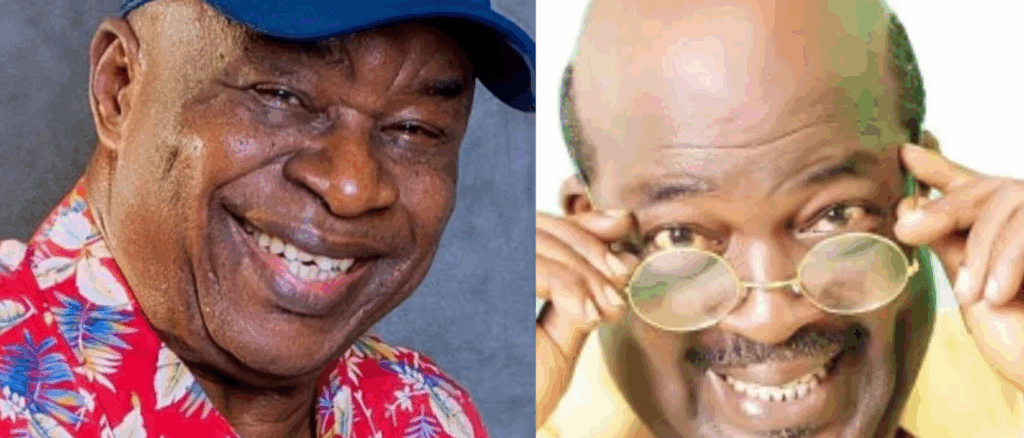
So, the drama around Abiodun Ayoyinka isn’t slowing down anytime soon, and now Wale Adenuga has finally stepped in to set the record straight.
It all started after Abiodun Ayoyinka, widely known as Papa Ajasco, went public with claims about his struggles and how things have been for him post fame. The interview quickly gained attention, with many Nigerians expressing sympathy and questioning how a once household name could be facing such challenges.
But according to Wale Adenuga, there is more to the story than what people are seeing online.
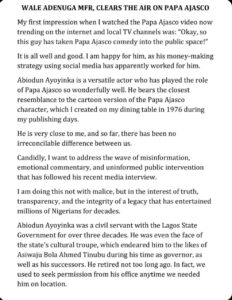

Responding to the interview, the veteran producer did not hold back. He suggested that the situation might not be as straightforward as it seems, even hinting that the attention the interview generated could have been part of a deliberate social media strategy, and in his words, it “worked.”
He went further to give his own account of how Abiodun Ayoyinka has been supported over the years.
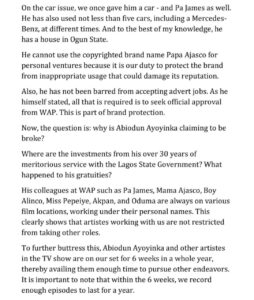

Adenuga revealed that at a point, he personally gifted cars to key cast members of the Papa Ajasco series, including Abiodun Ayoyinka and Pa James. According to him, Ayoyinka has used multiple vehicles over time, including a Mercedes-Benz, which paints a different picture from the struggling narrative many people had accepted.
He also added that, to the best of his knowledge, the actor owns a house in Ogun State, again challenging the idea that he has been completely abandoned or left without support.
But beyond the money conversation, Adenuga touched on something even more important, ownership and branding.
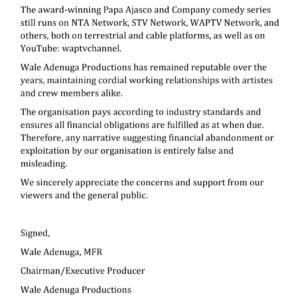

He made it clear that “Papa Ajasco” is not just a nickname. It is a copyrighted intellectual property under his company, WAP TV. This means the name cannot simply be used for personal projects or independent commercial activities without proper authorization.
According to him, when it comes to adverts or brand deals involving the character, all that is required is approval from WAP, implying that there is still a structured system in place for cast members to benefit, as long as the proper channels are followed.
He also addressed how the production itself works, explaining that cast members are not on set every day. Instead, they are called in as needed, meaning their involvement is more periodic than continuous, something he seemed to suggest people misunderstand when judging their earnings or visibility.
At its core, this situation is no longer just about one interview.
It has turned into a bigger conversation about fame, ownership, and what really happens behind the scenes of long running Nigerian TV classics like Papa Ajasco.
On one side, you have a beloved actor sharing his personal reality.
On the other, a producer defending the structure, support, and business behind the brand.
And somewhere in between all of that is the truth, likely more complex than either side is letting on.
But one thing is clear
This is not just nostalgia anymore.
It is a reminder that in entertainment, who owns the name can matter just as much as who made it famous.