
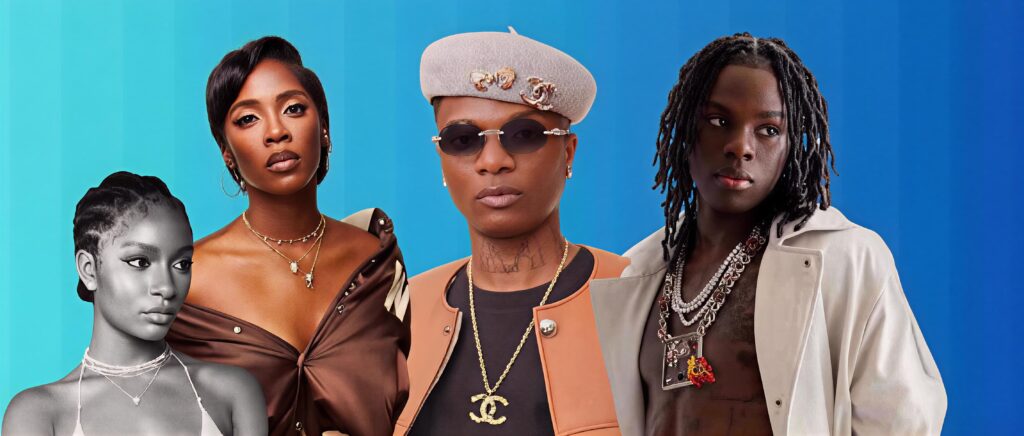
In Afrobeats, few conversations spark debate like the question of the “Big Three.” For years, the term has almost automatically referred to Wizkid, Burna Boy, and Davido, artists whose global success helped push Nigerian music to unprecedented international heights. The label has become so widely accepted that many fans now treat it as a fixed rule rather than an evolving conversation. So when Ayra Starr recently mentioned that her own “big three” would be Tiwa Savage, Wizkid, and Rema, some people reacted with surprise. But the truth is simple: Ayra Starr is absolutely allowed to make that choice.
The idea of a “big three” in music is never meant to be a universal law. It is usually a reflection of perspective, generational, artistic, or personal. For fans who grew up watching the global rise of Afrobeats in the 2010s, Wizkid, Burna Boy, and Davido represent the dominant trio that carried the genre onto global charts and stadium stages. But for younger artists like Ayra Starr, the story of Afrobeats looks slightly different. Their experience of the industry includes not only the pioneers of that global breakthrough but also the new wave of artists shaping its current evolution.
That is where names like Rema enter the conversation. Over the last few years, Rema has become one of the most influential artists of his generation, with global hits, major collaborations, and an unmistakable sound that resonates with younger audiences. To someone like Ayra Starr, who came up within the same modern Afrobeats wave, Rema represents not just success but also the future of the genre. Including him in her “big three” is less about replacing anyone and more about acknowledging the artists shaping the era she belongs to.
The inclusion of Tiwa Savage in her list also carries an important message. For a long time, the “big three” conversation in Afrobeats has been overwhelmingly male-dominated. Yet Tiwa Savage remains one of the most influential figures in African pop music, with a career that spans more than a decade and a catalogue that helped define modern Afrobeats. Even Tiwa herself has previously criticized the idea of reducing Afrobeats to only three names, arguing that the continent has too many talented artists for such a narrow label. By naming Tiwa as part of her own big three, Ayra Starr is also highlighting the impact of women in the industry, something that has often been overlooked in these debates.
Ultimately, conversations like this reveal something important about Afrobeats: the genre is too big to be contained by a single narrative. What used to be a small conversation about three dominant artists has now expanded into a global movement with multiple stars, multiple generations, and multiple perspectives. That means there will never be one definitive “big three.” There will only be different interpretations of influence.
And perhaps that is exactly how it should be. Because the moment a culture becomes too rigid about its heroes, it stops evolving. Afrobeats is evolving every day, and artists like Ayra Starr are simply expressing how they see that evolution.